
GL-2 Glass-Shield Extreme
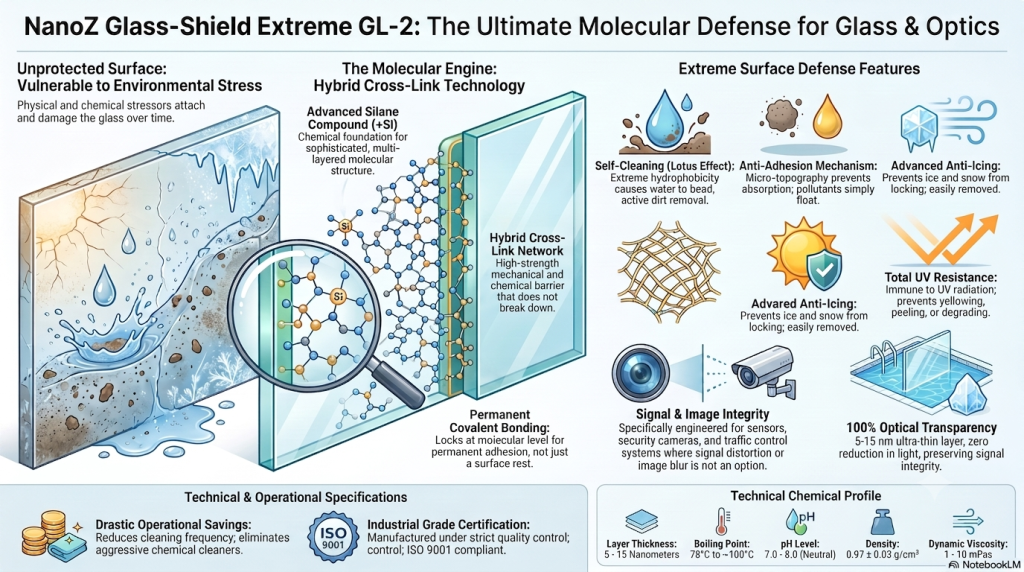
NanoZ Glass-Shield Extreme GL-2 is an ultra-thin nanometric coating with a molecular thickness of only 5 to 15 nanometers (nm). It is specifically engineered to provide maximum protection, surface preservation, and absolute optical clarity for glass structures and lenses operating under harsh environmental and extreme climatic conditions.
What is NANO-GLASS GL-2 ?
- Product Description & Technology
The formulation is based on an advanced silane compound (SI+) featuring a unique multi-layered cross-linked molecular network structure (protected intellectual property). The coating establishes a permanent, uniform covalent bond with the microscopic topography of the glass, creating an absolute “surface lock.” The coating is entirely resistant to intense UV radiation and does not degrade over years of exposure. It operates within a completely invisible spectrum (100% transparency), maintaining the native texture and optical properties of the substrate, while ensuring full light transmission across all wavelengths without reduction, distortion, or interference with optical data capture, filming, transmission, or signaling.
- Fields of Application & Targeted Uses under Harsh Conditions
The coating system is highly optimized to withstand dust, soot, contaminant accumulation, and freezing conditions across various critical applications:
Swimming Pools, Country Clubs, and Spa Environments: Provides comprehensive surface protection for glass partitions, safety railings, windows, and skylights against constant high humidity, aggressive chlorinated water spray, sun-tanning oils, and limescale buildup. The coating completely prevents glass etching (‘glass whitening’) and drastically simplifies the removal of dried mineral and salt residues.
Street Cameras, Traffic Control, and Roadside Optics: Delivers perimeter and active protection for the lenses and optical covers of speed cameras, urban security cameras, traffic sensors, and traffic mirrors exposed to volatile weather patterns and industrial pollution.
Soot and Road Dust Mitigation: Actively repels environmental dust particles, vehicle exhaust soot, oily traffic films, and bird droppings. Contaminants cannot adhere to the substrate and merely ‘float’ on top of the coating layer, preventing the formation of an opaque, cloudy film on the glass.
Anti-Icing and Frost-Rejection Effect: Features an advanced freeze-rejection mechanism that prevents snow, ice, and frozen dew from locking onto the glass surface. Enables quick and effortless removal of accumulated ice sheets via wind currents, rain, or a gentle wash, without scratching delicate optics.
Property / Parameter | Value / Technical Figure | Source / Remarks |
Base Solvent / Carrier | Ethanol | Flammable liquid product, Transport Cat: UN1933. Completely non-flammable after curing. |
Physical State | Fluid / Liquid | Suitable for precise, uniform mist spraying and wiping |
Appearance & Color | Transparent, completely colorless on surface | Ensures absolute optical clarity post-application and polishing |
Odor | Mild alcoholic odor during application only | Leaves no residual odor after complete evaporation |
Active Layer Thickness | 5 – 15 nanometers (nm) | Ultra-thin molecular layer; creates no visible sealing thickness |
pH Value (50% dilution in water) | 7.0 – 8.0 | Neutral; measured at a temperature of 20°C |
Boiling Point | ~78°C to 100°C | Controlled evaporation rate allowing optimal nano-crystallization |
Density | 0.97 ± 0.03 g/cm³ | Measured at a temperature of 20°C |
Dynamic Viscosity | 1 – 10 mPas | Measured at a temperature of 20°C |
Hazard Classification (CLP) | Not classified as hazardous to health | According to Regulation EC No 1272/2008 (excluding transport flammability) |
motion of the droplets during rain or wind actively captures environmental dirt, soot, and dust particles, lifting them completely off the surface as they exit.
- Typical Characteristics & Protective Benefits
Anti-Adhesion Mechanism: Locks directly into the microscopic boundaries of the glass, completely preventing external attacking agents from anchoring to or being absorbed by the substrate.
Enhanced Structural & Chemical Resistance: Provides outstanding mechanical durability against light abrasions and micro-scratches. The coating remains fully stable when exposed to almost all commercial, industrial, and household cleaning chemicals.
Efficient On-Site Renewal: Unlike legacy glazing technologies that require expensive dismantling and factory reprocessing, application and re-coating are performed easily directly on-site at the installation point.
Drastic Operational & Economic Savings: Preserves native optical transparency over long cycles, extends manual cleaning intervals multi-fold, and makes cleaning exceptionally easy without requiring aggressive, expensive chemical agents—a damp microfiber cloth or a light wipe is sufficient.
- Physical Data & Chemical Properties
MANDATORY SAFETY INSTRUCTIONS: |
- Application Instructions (DIY / Industrial Application)
Step A – Cleaning and Substrate Preparation
- Perform a thorough initial pre-cleaning of the glass surface or lens using NanoZ Z-200 deep-cleaning compound for older, heavily contaminated substrates (which entirely breaks down embedded soot, oils, limescale, and stubborn grime).
- Upon completing the pre-clean with Z-200, rinse the substrate completely with clean water to eliminate all product residues.
- The surface must be dried absolutely completely: Utilize only a fresh, clean, white paper towel for drying (avoid multi-use fabric cloths which can leave trace lint, fibers, or oily residue).
- For absolute deep microscopic purification, execute a final wipe using NanoZ CW-101 microscopic deep-prep treatment using pre-saturated wipes or by applying the liquid onto a clean paper towel or fresh microfiber cloth.
Step B – Coating Application
- Spray a fine ‘cloud-mist’ providing total coverage over the glass (ensure no product run-off, drips, or puddles form) using the specialized fine-atomizer spray bottle.
- To prevent reverse absorption from the substrate and ensure perfect leveling, take an application sponge, wrap it smoothly in clean white paper, and apply 2–3 initial priming sprays directly onto it.
- Spread and rub the liquid gently in overlapping circular motions across the surface without applying heavy mechanical pressure.
- Recommended working area: Work in controlled, separate sections of up to half a square meter (0.5 m²) at a time.
Step C – Finishing and Optical Polishing
- Allow the coating to rest for 15–25 minutes (depending on environmental ambient temperature and humidity levels) to facilitate initial nano-particle cross-linking and bonding with the glass.
- Using a fresh, dry, clean white paper towel (without the application sponge), polish the surface gently in circular motions (without excessive downward force) to clear away any cured excess material or residual haze until absolute high-gloss reflection, maximum clarity, and perfect optical transparency are achieved.
- For large-scale industrial applications: The cleaning, mist spraying, and polishing stages can be integrated with automated spray systems and standard mechanical polishing machinery.
- Drying & Activation Times
Initial Hydrophobic Activation: The surface transforms into an active water and dirt repellent state within 2 to 3 hours following the optical polishing phase.
Final Full Cure: Ultimate curing, cross-linking, and maximum chemical/abrasion resistance are reached after 24 hours at standard room temperature.
- Storage Conditions & Shelf Life
Product Storage: Store exclusively within the original manufacturer container, tightly sealed, in a cool, shaded, sheltered, and well-ventilated space designated for ethanol-based materials, away from any heat sources, sparks, or ignition points.
Storage Restrictions: Strictly prohibited from being stored alongside pharmaceuticals, food products, animal feed, or infectious, radioactive, and explosive compounds.
Allowable Storage Temperature: Maintain strictly between 3°C and 40°C. WARNING: Product that has undergone freezing is permanently damaged and unusable.
Shelf Life: The product remains fully stable and valid for high-performance application for up to 18 months from the date of manufacture under the specified storage parameters.


